 The Antitrust Attorney Blog


Authors: Pat Pascarella & Luke Hasskamp
Recent proceedings involving Apple Inc.—including the U.S. Department of Justice case and Epic Games v. Apple—together with developments in AI markets, suggest an evolving framework for platform-focused antitrust analysis. This article considers how those threads may fit together.
I. The DOJ Has Done Substantial Groundwork
Begin with market power. In U.S. v. Apple, the district court accepted as plausible a U.S. smartphone market in which Apple holds roughly 65%—now closer to 70%—reinforced by barriers to entry, network effects, and switching costs.
The DOJ also presents an alleged pattern of exclusionary conduct: the repeated neutralization of technologies that reduce platform dependence, including middleware, super apps, cloud streaming, smartwatches, messaging, and digital wallets. According to the complaint, each time a product threatened to make device choice less consequential, Apple constrained or neutralized it. If this allegation is supportable, such a pattern could address concerns about improperly “punishing success.”
II. The Markets Apple Controls at 99 Percent
If a higher market share is needed, the more compelling market is not some smartphone submarket. Rather, it will be markets Apple controls at 99 percent: the iOS functionalities and apps themselves. While not every function is a separate product, some may well be—particularly those Apple allegedly targets.
Epic v. Apple is instructive on this point, and not fatal. The court did not hold that iOS-tethered markets are inherently non-cognizable—only that Epic failed to establish that consumers lacked awareness of iOS restrictions and could not factor them into purchasing decisions. But those gaps seem addressable.
The full scope of any restraints—and their costs—is obscured in a dense web of contractual and technical restrictions. No reasonable consumer could anticipate the extent to which app review, API access, and distribution control could be wielded against rivals. Nor should antitrust liability turn on whether consumers anticipated unlawful conduct.
Even if consumers had advance knowledge of such restraints, a single-brand market is not foreclosed. Apple’s own counsel acknowledged in Epic that consumers entering the iOS ecosystem cannot predict downstream costs related to app distribution, in-app payments, or aftermarkets. If the costs of any restraints are unknowable at the time of purchase, foremarket competition cannot discipline aftermarket conduct. The remaining elements of a single-brand iOS functionality or app market also appear to be present, including allegations of intentional degradation of interoperability to maintain switching costs—without corresponding loss of share or margin.
III. CoStar, Exclusive Dealing, and the End User License Agreement
Some claims may not require pleading a single-brand market. For example, under the Ninth Circuit’s decision in CoStar v. CREXi, “substantial foreclosure” is sufficient to plead an exclusive dealing agreement.
The agreement? The EULA itself. While a web of contractual and technical restrictions might enable foreclosure, the enforceable agreement between Apple and the user is embodied in the EULA. In that sense, Apple may have supplied potential plaintiffs with the central instrument of its own potential liability.
IV. The EULA as a Negative Tie
The EULA may also provide a foundation for tying claims. Courts often resist tying theories in platform cases, frequently reasoning that coercion must be directed at consumers rather than suppliers. That argument, though contestable, is predictable.
A potential response may be that it is the EULA that effectively conditions use of the platform on the consumer’s agreement not to obtain competing products, services, or apps outside Apple’s approval.
V. Attempted Monopolization and Dangerous Probability of Success
Tying allegations also expand the analytical framework, though courts ultimately may analyze them as attempted monopolization. On the “dangerous probability of success,” a defendant such as Apple likely would invoke concerns about outdated leveraging theories. But this would not be a classic leveraging case.
Any company that demonstrates both the ability and the willingness to neutralize technologies or rivals that threaten its market position may struggle to characterize that conduct as competing on the merits. Such a pattern should reduce concerns about punishing a company simply for being successful. Where a company has demonstrated a pattern of exclusion and retains the ability to repeat it, the “dangerous probability” standard should be satisfied.
VI. Inextricably Intertwined—and Antitrust Standing
A direct monopolization claim targeting the U.S. smartphone market faces a threshold question: standing. Developers and rivals operating at the functionality level are neither customers nor competitors in the smartphone market.
Consider: “Inextricably intertwined.” Any firms harmed directly by conduct designed to entrench Apple’s ecosystem and raise switching costs are likely not incidental victims. Their injury would be the very mechanism through which competition is allegedly harmed. That alignment supports standing without requiring plaintiffs be competitors or buyers in the smartphone market.
These plaintiffs also are likely well-positioned as the most efficient enforcers due to their unique ability to detect predatory conduct. And because the alleged harm is direct, there is little risk of duplicative recovery.
VII. Microsoft, Not U.S. v. Apple, is the Precedential Anchor
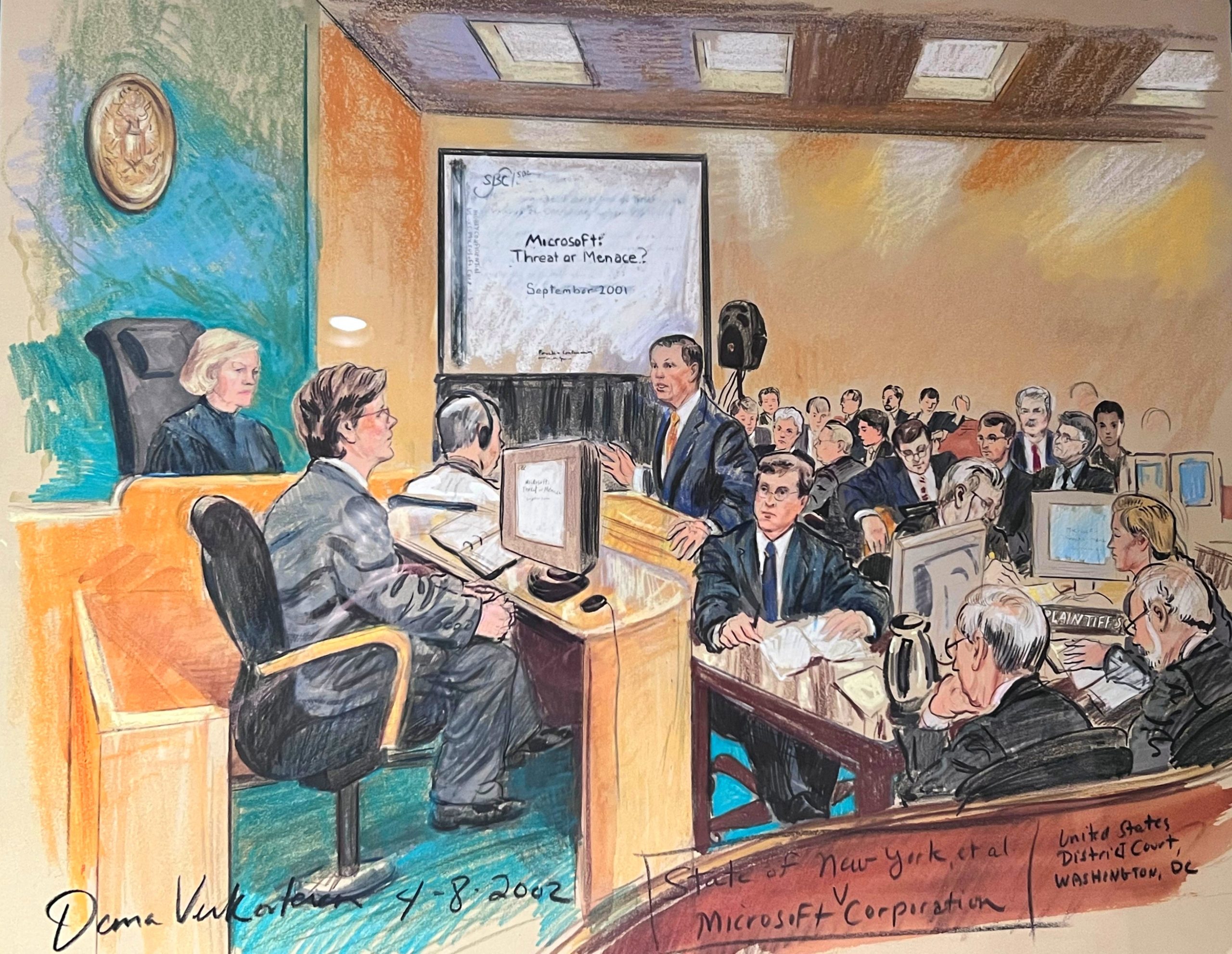
While U.S. v. Apple and Epic are instructive, U.S. v. Microsoft is more likely the template to challenge any anticompetitive conduct by a platform. Microsoft established that a dominant platform’s use of contractual restrictions and technological shackles to exclude middleware that threatens its operating-system monopoly is exclusionary conduct under Section 2—not competition on the merits.
The historical irony is worth noting: during the Microsoft trial, an Apple executive testified about Microsoft’s efforts to undermine Apple’s cross-platform technology, QuickTime, to preserve its operating system dominance. The resulting ruling constrained Microsoft’s conduct and helped create the competitive space in which Apple introduced the iPod, iTunes, and ultimately the iPhone.