Articles Posted in Monopoly and Dominance

Articles that discuss antitrust and competition issues involving monopolists, dominant companies, monopoly power, and dominance.

Author: Pat Pascarella

AI will weaponize antitrust. AI markets have high fixed costs, winner-take-all dynamics, platform leverage, bundling power, and data lock-in.  These dynamics predict concentration.  And market concentration is an accelerant for antitrust litigation—both private and government. We saw it with IBM, Microsoft, and the telecom wars.

Private actions will move faster than government enforcers—not because they are necessarily stronger on the merits, but because they are less constrained by politics and bandwidth. A well-timed complaint can slow a rival’s rollout, trigger regulatory scrutiny, and create settlement leverage.  When markets tip quickly, the losers litigate.

Amazon-Germany-300x134

Author: Luis Blanquez

On 5 February 2026, Germany’s competition authority, the Bundeskartellamt, announced a landmark ruling prohibiting Amazon from continuing practices that influenced how independent sellers priced their products on the German Amazon Marketplace. The authority also ordered Amazon to disgorge €59 million in economic benefits that it determined were gained through these anticompetitive practices.

At the center of the ruling lies Amazon’s dual role in Germany’s online retail ecosystem. As in the United States, the company not only sells products through its own retail arm, Amazon Retail, but also operates the Amazon Marketplace, a platform where independent third‑party sellers list and sell goods directly to consumers. About 60% of all items sold on Amazon.de come from these independent sellers, who bear full responsibility for setting prices and managing the financial risks of their businesses.

The Bundeskartellamt concluded that Amazon used a variety of “price control mechanisms” to review whether sellers’ prices were “too high.” When Amazon’s systems flagged a price as unacceptable, the company responded by either fully removing the listing from the platform or excluding the offer from the Buy Box—the prominent purchasing option that strongly influences sales volume. These measures can severely limit a seller’s visibility and revenue.

According to the authority, this system created a significant competitive imbalance. President Andreas Mundt emphasized that Amazon directly competes with the very sellers who rely on its platform. When a dominant marketplace operator can restrict or manipulate competitor pricing—even indirectly through algorithmic controls—it risks shaping the entire price landscape according to its own commercial interests. Mundt warned that such interference could prevent sellers from covering their costs, potentially pushing them off the marketplace entirely.

The Bundeskartellamt made clear that it does not object to Amazon’s ambition to offer low prices to consumers. Instead, the issue lies in how Amazon has attempted to achieve that goal. Regulators argue that Amazon can provide competitive prices without directly constraining the pricing choices of independent sellers. To address the issue, the authority has restricted Amazon from using price control tools except under narrowly defined circumstances—particularly cases of excessive or exploitative pricing—and only in compliance with detailed requirements that the Bundeskartellamt has now established.

The regulator highlighted the implications of Amazon’s market position. Amazon accounts for roughly 60% of Germany’s online goods retail market, making it an undeniably influential digital gatekeeper. Because independent sellers depend heavily on Amazon’s infrastructure and visibility, any internal policy that affects pricing can have sweeping economic impact. The authority asserts that Amazon’s previous practices allowed it to act as both a competitor and an arbiter of acceptable pricing behaviors, creating a structural conflict of interest.

By limiting Amazon’s ability to use these mechanisms, the Bundeskartellamt aims to restore pricing freedom to third‑party sellers and safeguard the competitive process. The decision stresses the need to prevent dominant digital platforms from exploiting their market position by embedding competitive advantages into the algorithms and systems that govern visibility, listing status, and price acceptability. According to the authority, this type of intervention is crucial to ensuring that Amazon cannot extend its competitive power on the marketplace into the broader retail economy.

Continue reading →

Oligopoly-Competition-Antitrust-300x193

Author: Ruth Glaeser

Recent news highlights a growing focus on government antitrust enforcement cases against companies accused of monopolizing markets and abusing their power. But let’s consider another question: if a company lacks sufficient market power to qualify as a monopolist, but competes with only one or a handful of other companies, how does that affect consumer welfare?

American antitrust law seems to champion consumer choice untainted by anticompetitive practices. But it does not prohibit the market dynamic known as an oligopoly, which is a structure prevalent in numerous industries across the United States and the world. In an oligopoly, a small number of firms effectively control the quality, pricing, and supply of a particular market. This departure from perfect competition typically leads to some combination of higher prices and lower quality, and possibly less innovation and fewer consumer choices.

Consider the air-travel industry, where major players like Delta, American Airlines, United, and Southwest hold substantial influence over consumers. Similarly, when purchasing technology devices, most consumers find themselves choosing among a limited array of manufacturers, such as Apple, Samsung, and others. While no single entity monopolizes the market, collectively these firms exert significant control, raising concerns about the implications for consumer choice and pricing.

As the landscape of market power continues to evolve, understanding the dynamics of oligopolies becomes increasingly crucial for consumer welfare.

What is an Oligopoly?

An oligopoly is a market structure characterized by a small number of firms, usually fewer than five, that collectively account for a substantial share of the market. These firms are generally interdependent and the decisions of one firm often directly influence the behavior and profitability of the others. Their interdependence can lead to anticompetitive behaviors, including aggressive pricing to tacit collusion. These practices may harm  competition and consumers.

One of the largest threats to competition from oligopolistic behavior is conscious parallelism. Conscious parallelism occurs when firms in a competitive market make aligned decisions without direct communication or collusion. Instead, each firm observes the actions of its competitors, and reacts accordingly, often leading to similar pricing strategies, product offerings, or marketing tactics. Sometimes, there is one company, often the largest, that will start the merry-go-round, and smaller companies will follow the leader.  Importantly, conscious parallelism is not itself illegal under the antitrust laws, but its effects can mimic the anticompetitive results of monopolies.

There are several ways in which a market can become an oligopoly. The most common are high barriers to entering a market and the need for economies of scale. Many industries, such as the airline industry, require significant financial investment, which can deter new entrants. Relatedly, established firms often benefit from economies of scale, which allow them to produce at lower costs than new entrants, making it hard for smaller firms to compete on price. Sometimes companies may merge or acquire competitors to facilitate this, which reduces market competitors and increases a firm’s market share.

Moreover, it is common for government regulations to create or sustain oligopolies, such as in the utility industry, where governments may grant exclusive rights to certain firms to operate in specific regions, limiting competition, and controlling pricing. And government regulation itself tends to increase economies of scale, which tends to move markets from competitive toward oligopolistic. Indeed, if the federal government truly cared about increasing competition, it would take a long-hard look at excessive, unnecessary regulations that increase market-entry barriers.

Risk of Anticompetitive Behavior

An oligopoly presents a risk for several types of anticompetitive behavior:

  • High Potential for Price Fixing

Price fixing occurs when a small number of firms in the oligopoly agree to set prices at a certain level, rather than allowing competition to determine them. A notable example is the case of In re Domestic Drywall Antitrust Litigation, which involved seven defendant drywall manufacturers, four of which were responsible for approximately 70% of the market share. Plaintiffs alleged that these drywall manufacturers engaged in collusion to raise prices by 35%, announcing the increase to customers well in advance. This move came at a time when the industry was facing a surplus of product alongside a decline in demand. While the case was settled before reaching trial, the court’s findings suggested that the price hike was free from illegal collusion among Defendants.

  • High Potential for Conscious Parallelism

Conscious Parallelism poses a significant challenge to competition. This phenomenon occurs when firms coordinate their behavior without any explicit communication or agreement, often leading to artificially inflated prices. A prime example is Holiday Wholesale Grocery Co. v. Phillip Morris Inc, where Phillip Morris, a dominant player in the cigarette market, announced a substantial price reduction on its premium products. Its three main competitors quickly followed suit, controlling approximately 95% of the market.

Continue reading →

large-monopoly-bus-300x169

Author: Jarod Bona

Do you or your competitor have a monopoly in a particular market? If so, your conduct or their conduct might enter Sherman Act, Section 2 territory, which we call monopolization.

If you are in Europe or other jurisdictions outside of the United States, instead of monopoly, people might label the company with extreme market power as “dominant.”

Of course, it isn’t illegal itself to be a monopolist or dominant (and monopoly is profitable). But if you utilize your monopoly power or obtain or enhance your market power improperly, you might breach US, EU, or other antitrust and competition laws.

In the United States, Section 2 of the Sherman Act makes it illegal for anyone (person or entity) to “monopolize any part of the trade or commerce among the several states, or with foreign nations.” But monopoly, by itself, is not illegal. Nor is it illegal for a monopolist to engage in competition on the merits.

If you are interested in learning more about abuse of dominance in the EU, read this article.

In the United States, monopolists have more flexibility than in the EU, but they are still under significant pressure and could face lawsuits or government investigations at any time, even when they don’t intend to violate the antitrust laws. There can be a fine line between strong competition on the merits and exclusionary conduct by a monopolist.

Here are the elements of a claim for monopolization under Section 2 of the Sherman Act:

  • The possession of monopoly power in the relevant market.
  • The willful acquisition or maintenance of that power as distinguished from growth or development as a consequence of a superior product, business acumen, or historic accident.

These two basic elements look simple, but you could write books about them.

The Possession of Monopoly Power in the Relevant Market

To determine whether an entity has monopoly power, courts and agencies usually first define the relevant market, then analyze whether the firm has “monopoly” power within that market.

But because the purpose of that analysis is to figure out whether certain conduct or an arrangement harms competition or has the potential to do so, evidence of the actual detrimental effects on competition might obviate the need for a full market analysis. If you want to learn more about this point, read FTC v. Indiana Federation of Dentists (and subsequent case law and commentary). You can show monopoly power directly.

Sometimes this element leads to difficult questions about the line between monopoly power in a relevant market and something slightly less than that. Other times, the monopoly-power element comes down to how the court will define the relevant market. A broader market definition may create a finding of no monopoly power, while a more narrow definition means the powerful company has monopoly power.

Continue reading →

Apple-Store-Antitrust-and-Competition-EU-and-US-300x225

Author: Luis Blanquez

Apple is currently feeling the heat from antitrust authorities all over the world. Probably more than ever. Below is an article we recently published in the Daily Journal discussing in some detail the last developments in the Epic Games saga, both in the EU and the US.

Epic Games Has Returned to the Apple Store. Will Apple Throw a Hail Mary?

If you are a developer in the Web3 space trying to access the Apple Store, you should also review this article:

Antitrust, Web3 and Blockchain Technology: A Quick Look into the Refusal to Deal Theory as Exclusionary Conduct

So, what’s on Apple’s plate in the antitrust world on both sides of the pond?

In the European Union, the European Commission has fined Apple over €1.8 billion for abusing its dominant position on the market for the distribution of music streaming apps to iPhone and iPad users (‘iOS users’) through its App Store. The Commission found that Apple applied restrictions on app developers preventing them from informing iOS users about alternative and cheaper music subscription services available outside of the app. Such anti-steering provisions ban app developers from the following:

  • Informing iOS users within their apps about the prices of subscription offers available on the internet outside of the app.
  • Informing iOS users within their apps about the price differences between in-app subscriptions sold through Apple’s in-app purchase mechanism and those available elsewhere.
  • Including links in their apps leading iOS users to the app developer’s website on which alternative subscriptions can be bought. App developers were also prevented from contacting their own newly acquired users, for instance by email, to inform them about alternative pricing options after they set up an account.

At the same time, the European Commission has just opened a non-compliance investigation under the new Digital Markets Act about Apple’s rules on (i) steering in the App Store; (ii) its new fee structure for alternative app stores; and (iii) Apple’s compliance with user choice obligations––to easily uninstall any software applications on iOS, change default settings on iOS and prompt users with choice screens which must effectively and easily allow them to select an alternative default service.

Meanwhile, antitrust enforcement is also heating up for the Cupertino company in the United States.

Besides several private litigation actions, Epic Games recently filed a motion accusing Apple of violating an order issued last year under California law barring anti-steering rules in the App Store.

And just few days ago, the Justice Department, joined by 16 other state and district attorneys general, filed a civil antitrust lawsuit against Apple for monopolization or attempted monopolization of smartphone markets in violation of Section 2 of the Sherman Act. According to the complaint, Apple has monopoly power in the smartphone and performance smartphones markets, and it uses its control over the iPhone to engage in a broad, sustained, and illegal course of conduct. The complaint alleges that Apple’s anticompetitive course of conduct has taken several forms, many of which continue to evolve today, including:

  • Blocking Innovative Super Apps.Apple has disrupted the growth of apps with broad functionality that would make it easier for consumers to switch between competing smartphone platforms.
  • Suppressing Mobile Cloud Streaming Services. Apple has blocked the development of cloud-streaming apps and services that would allow consumers to enjoy high-quality video games and other cloud-based applications without having to pay for expensive smartphone hardware.
  • Excluding Cross-Platform Messaging Apps. Apple has made the quality of cross-platform messaging worse, less innovative, and less secure for users so that its customers have to keep buying iPhones.
  • Diminishing the Functionality of Non-Apple Smartwatches. Apple has limited the functionality of third-party smartwatches so that users who purchase the Apple Watch face substantial out-of-pocket costs if they do not keep buying iPhones.
  • Limiting Third Party Digital Wallets. Apple has prevented third-party apps from offering tap-to-pay functionality, inhibiting the creation of cross-platform third-party digital wallets.

The complaint also alleges that Apple’s conduct extends beyond these examples, affecting web browsers, video communication, news subscriptions, entertainment, automotive services, advertising, location services, and more.

Continue reading →

NBA-and-Rival-Basketball-League-Antitrust-200x300

Authors: Luke Hasskamp & Molly Donovan

NBA action is FAN-TASTIC! Unless, of course, the action is one brought by the Department of Justice in a different kind of court. But that may be exactly where the NBA finds itself: the DOJ is reportedly investigating the professional basketball association for alleged antitrust violations. The NBA’s alleged anticompetitive conduct targeted Big3, a competitive basketball league founded by Ice Cube and entertainment executive Jeff Kwatinetz (with Clyde Drexler serving as commissioner!). That conduct included allegedly pressuring team owners, current NBA players, and advertisers and partner television networks not to do business with Big3.

Big3 is an aptly named 12-team, 3-on-3 league mostly comprised of retired NBA players. Teams play an eight-week season, followed by a two-week, four-team playoff, all during the NBA’s off-season. In 2023, the Big3’s regular season was held once a week in Chicago, Dallas, Brooklyn, Memphis, Miami, Boston, Charlotte, and Detroit, and the finals were held in London, England.

We’ve previously written about antitrust laws in the sports arena, including the infamous antitrust exemption in professional baseball. But baseball is an anomaly in that regard, as all other professional sports in the United States are subject to federal antitrust laws. (Professional football, baseball, basketball, and hockey are statutorily exempted from antitrust laws for negotiating television broadcast rights. See 15 U.S.C. § 1291.) Thus, antitrust liability is fair game for the NBA.

And, as this story broke, another recent antitrust case jumped to mind: that involving the PGA Tour and LIV Golf, when the PGA Tour faced antitrust scrutiny for its decision to suspend players who played for a would-be competitor league. The NBA dispute has many parallels to the PGA Tour case, though with some notable differences too, even though most details are not public.

To consider the legal nuts and bolts a bit, let’s look at what a Section 1 and Section 2 claim against the NBA might look like.

Section 1 of the Sherman Act – Unlawful Agreements

Federal antitrust laws (Section 1 of the Sherman Act) make it unlawful for two or more actors to enter agreements (conspiracies) to restrain trade or competition in the market. Classic examples include price fixing and group boycotts.

Here, the leading legal theory may be the group boycott. Under that theory, the NBA would have entered into one or more agreements with other entities to thwart Big3’s emergence and growth in the market.

One of the improper agreements reported here is between the NBA and the owners of each of its 30 teams, with the NBA allegedly instructing owners to not invest in the fledgling competitor. (An agreement between a sports league and its individual teams can implicate Section 1 of the Sherman Act, as was the theory in the recently-settled litigation against MLB involving the contraction of minor league teams.) The reports also suggest that the NBA may have persuaded sponsors and other business partners to agree to avoid doing business with Big3.

Section 2 of the Sherman Act – Monopolization 

Federal antitrust laws also make it illegal for a monopolist to preserve its dominant market position through anticompetitive conduct. And this section of the Sherman Act does not require collusion with another party—a single actor can incur liability.

Here, the NBA sure looks like a monopoly (or monopsony). It’s the dominant actor in the professional basketball market in the United States, with revenues exceeding $10 billion per year. (While we generally assume that the relevant geographic market is the United States, even if we were to consider the entire world, the NBA may still be a monopolist.) In professional basketball, there is no rival to the NBA. If you are an elite basketball player in the United States, the NBA is pretty much the only place to play (even if you include the Big3).

But the NBA’s status as a monopoly is not unlawful on its own. It’s fine for a business to emerge as a dominant market player through lawful means, such as through “a superior product, business acumen, or historic accident.” United States v. Grinnell Corp., 384 U.S. 563, 570­71 (1966).

Instead, to implicate Section 2 of the Sherman Act, the NBA must have engaged in some “exclusionary” or “anticompetitive” conduct to protect its monopoly and harm competition—that is something other than superior product, business acumen, or historic accident. Examples of exclusionary conduct include tying, exclusive dealing, predatory pricing, defrauding regulators or consumers, or engaging in coercive conduct, such as threatening customers with retaliation if they choose to do business with the would-be competitor in order to stifle the competitor’s growth in the market.

Continue reading →

Antitrust-for-Kids-300x143

Author:  Molly Donovan

At Argo Elementary, a group of kids gathers daily at lunch to buy and sell candy. The trading activity is a longtime tradition at Argo and it’s taken very seriously—more like a competitive sport than a pastime.

Candy trading doesn’t end once a 5th grader graduates from Argo. It continues across town at Chicago Middle School—but instead of lunch, candy trading happens there at the close of each school day. (The middle school had banned lunchtime trading due to several disputes that grew out of hand.)

Now here’s where it gets complicated, and nobody knows why it works this way, but the average lunchtime price at Argo determines the starting price for trades later in the day at Chicago.

For example: the average selling price for a candy bar on Monday, lunch at Argo is $2.50. Monday after-school prices at Chicago also will start at $2.50.

There are rules about what kind of candy can be traded—so that one trade can be easily compared to another (candied apples-to-candied apples) for purposes of determining who’s “winning.”

And sometimes kids—particularly the older ones at Chicago—place bets on what will happen on a particular trading day in the future, e.g., I bet prices will reach $3 or I bet no more than 50 candy bars will get sold this Friday.

That’s it by way of background. Here’s our story.

Arthur D. Midland (“ADM”) is 9. He is the link between Argo and Chicago. Each day, ADM leaves Argo Elementary when school lets out, walks to Chicago Middle, announces the “start-of-trade” Chicago price based on the lunchtime Argo price, and Chicago trading begins. (ADM’s mother allows this because ADM’s older brother (Midas) also trades at Chicago—so the two boys can watch each other.)

At the start of the school year, ADM contrived a very clever scheme. He bet Midas that, on Halloween, Chicago prices would be very low—as low as $1. Midas said, “No way! September prices are already at $2.50. If anything, prices will increase as kids go candy crazy in October. I’ll take that bet.”

So, for every candy bar sold at Chicago on Halloween for $1 or less, Midas would owe ADM $1. And for every candy bar sold at Chicago for more than $1, ADM would owe Midas $1.

With that bet front of mind, ADM became the primary candy seller at Argo, and as Halloween neared, he flooded Argo with candy and sold it intentionally at very low prices—50 cents for a Snickers! (ADM had the requisite inventory because he was an avid trick-or-treater and had saved all his Halloween candy from years past.)

Due to ADM’s scheme, Argo prices got so low that some kids packed up their candy and went home—refusing to trade there at all.

Well, Halloween finally came and, as you can imagine, ADM made a killing on the bet—100 candy bars were sold at Chicago on Halloween at less than $1, forcing Midas to pay ADM his entire savings. This more than compensated ADM for whatever losses he incurred for under-selling at Argo.

Once Midas realized ADM’s trick, he was furious. Didn’t ADM cheat? Midas assumed—as did all candy traders—that bets derived from candy sales would be based on real—not artificial—market forces.

Did ADM get away with it?

So far, no.

My Muse: For now, plaintiff Midwest Renewable Energy has survived a motion to dismiss its Section 2 monopolization claim against Archer Daniels Midland.

The claim is based on allegations of predatory pricing—basically that the defendant’s prices were below an appropriate measure of its costs and that the low prices drove competitors from the market allowing the defendant to recoup its losses. (For more on predatory pricing, read here.)

In the ADM case, Midwest alleges that ADM manipulated ethanol-trading prices at the Argo Terminal in Illinois to create “substantial gains” on short positions ADM held on ethanol futures and options contracts traded on the Chicago Mercantile Exchange. Because the Argo prices determined the value of the derivatives contracts, by flooding Argo with ethanol that ADM sold at too-low prices, ADM allegedly was able to win big on the derivatives exchange—recouping whatever losses it incurred on the underlying asset.

On its motion to dismiss, ADM argued that Midwest had not sufficiently alleged that ethanol producers had exited the market due to ADM’s low prices or that ADM subsequently recouped its losses in the ethanol market. (ADM classed these arguments as going to antitrust injury.)

The Court agreed that Midwest was required to allege both that rivals exited the market and that recoupment was ongoing or imminent, but the court ruled Midwest’s allegations sufficient to do so.

Specifically, Midwest had alleged that 12 ethanol producers had either stopped or decreased ethanol production—which is enough at the motion to dismiss phase. The court said whether that alleged “handful” of plant closures had a discernible effect on consumers is a fact-intensive analysis not susceptible to resolution on the pleadings.

Continue reading →

Blockchain-and-refusal-to-deal-antitrust-225x300

Author: Luis Blanquez

A company using a blockchain––or perhaps even the blockchain itself––, with a sizeable share of a market, could be a monopolist subject to U.S. antitrust laws. But monopoly by itself isn’t illegal. Rather, a company must use its monopoly power to willfully maintain that power through anticompetitive exclusionary conduct.

Thus, a monopolization claim requires: (i) the possession of monopoly power in the relevant market––i.e. the ability to control output or raise prices profitability above those that would be charged in a competitive market; and (ii) the willful acquisition or maintenance of that power as distinguished from attaining it by having a superior product, business acumen, or even an accident of history. United States v. Grinnell Corp., 384 U.S. 563, 570-71 (1966).

The monopolist may also have a legitimate business justification for behaving in a way that prevents other firms from succeeding in the marketplace. For instance, the monopolist may be competing on the merits in a way that benefits consumers through greater efficiency or a unique set of products or services.

There are many ways a company may willfully acquire or maintain such monopoly power through anticompetitive exclusionary conduct. Some of them include exclusive supply or purchase agreements, tying, bundling, predatory pricing, or refusal to deal.

In this article we briefly discuss the refusal to deal theory of harm in the context of web3.

What is Web3?

The internet is an evolving creature. Thirty years ago, web 1.0 was all about browsing and reading information. As a consumer you had access to information, but few were able to publish online.

In the early 2000s the current web 2.0. arrived, and everyone started publishing their own web content and building communities. The problem today is that we have a centralized internet. Very few companies––big online platforms such as Google, Facebook or Amazon––control and own everyone’s online content and data. And they even use all that data to make money through, for instance, targeted advertising.

That’s why web3 is a necessary step in the right direction. As a consumer you can now access the internet without having to provide your personal data to these online gatekeepers. And you don’t need to give up ownership of the content you provide. Plus, you own your digital content and can execute digital agreements using crypto currencies. If wonder how is all that possible, the answer is through a new infrastructure called blockchain.

You can read a broader discussion of antitrust guidelines for companies using blockchain technology here.

Refusal to Deal with Competitors or Customers

Competitors and Rivals

First, an illegal refusal to deal may occur when the monopolist refuses to deal with a competitor or rival. Under US antitrust laws such claims are challenging and rarely successful.

Although a company generally has no duty to deal with its rivals, courts have found antitrust liability in some limited scenarios when a monopolist (i) unilaterally outright refuses to sell a product to a rival that it made available to others (Verizon Commc’ns, Inc. v. Law Offs. of Curtis V. Trinko, LLP, 540 U.S. 398, 407–09 (2004), see also Aspen Skiing, 472 U.S. at 601; Otter Tail Power Co. v. United States, 410 U.S. 366, 377-78 (1973); OR (ii) had a prior voluntary and presumably profitable course of dealing with a competitor, but then terminated the relationship, giving up short-term profit from it in order to achieve an anticompetitive end. See Pac. Bell Tel. Co. v. linkLine Commc’ns, 555 U.S. 438, 442, 451 (2009), Novell, Inc. v. Microsoft Corp., 731 F.3d 1064 (10th Cir. 2013), cert. denied, 572 U.S. 1096 (2014).

Applied to the web3 world, this means that the validators of a blockchain could face antitrust scrutiny only if they had monopoly power, and (i) they previously allowed a competitor access to its blockchain but later agreed to exclude that rival, or (ii) sacrifice short-term profits without a reasonable business justification. This is, of course, unlikely considering the decentralized structure of blockchains and their need for gas fees to keep validators’ business profitable and the chain secured. When the validators are decentralized, they are not a single economic entity for purposes of the antitrust laws. But the risk would still differ depending on the blockchain and the level of decentralization.

What we might eventually see, however, is a company with monopoly power using a blockchain to exclude its rivals from the market through different anticompetitive conduct. For instance, we might see restrictions to only use one blockchain, to use smart contracts to impose loyalty rebates and other barriers to switch between blockchains, conditioning the use of one blockchain for a specific application or product by restricting the use of other blockchain or non-blockchain rivals’ infrastructure, or to require suppliers upstream or end customers downstream, to use the same blockchain for different products or applications.

Customers

Second, a refusal to deal may also take place when a monopolist refuses to deal with its customers downstream or suppliers upstream. A monopolist’s refusal to deal with customers or suppliers is lawful so long as the refusal is not the product of an anticompetitive agreement with other firms or part of a predatory or exclusionary strategy. Note, however, that a monopolist cannot decline to deal with customers as retaliation for those customers’ dealings with a competitor. That is often called a refusal to supply and is in a different doctrinal category than a refusal to deal. But, beyond these anticompetitive exceptions, private companies are typically free to exercise their own independent discretion to determine with whom they want to do business.

This test is broader than the one for competitors and requires a case-by-case legal and economic analysis to determine whether anticompetitive conduct exists. And web3 is not any different in this respect.

The Apple App Store and web3

Let’s take the Apple App Store as an example.

In the web2 world, Apple has created a “walled garden” in which Apple plays a significant curating role. Developers can distribute their apps to iOS devices only through Apple’s App Store and after Apple has reviewed an app to ensure that it meets certain security, privacy, content, and reliability requirements. Developers are also required to use Apple’s in-app payment processor (IAP) for any purchases that occur within their apps. Subject to some exceptions, Apple collects a 30% commission on initial app purchases and subsequent in-app purchases.

There are currently several related ongoing antitrust investigations and litigations worldwide about Apple’s conduct with its App Store. In the U.S., the Court of Appeals from the Ninth Circuit on the Epic Games saga held that Apple should not be considered a monopolist in the distribution of iOS apps. But this ruling also came with a string attached. The judge concluded that Apple did violate California’s unfair competition law and could not maintain anti-steering rules preventing users from learning about alternate payment options. If you want to learn more (see here). Both companies have recently asked the Ninth Circuit for a rehearing and the stakes are high.

Companies in web3 are now starting to deal with similar potentially anticompetitive behavior from web2 big tech companies. Uniswap, StepN and Damus are just three of many recent examples.

Continue reading →

Barry-Hawk-Monopoly-in-America-226x300

Author: Steven Cernak

Most antitrust practitioners, even members of the general public, have a good intuitive sense of what Sherman Act Section 1 is aimed at. Whether you follow the common law’s ancient voiding of “combinations in restraint of trade,” as does Greg Werden for example, or your kindergarten teacher’s instruction to avoid “ganging up,” as explained by Dick Steuer, even beginning antitrust students understand that certain agreements are bad for competition and, so, should be illegal.

But what about Sherman Act Section 2’s prohibition of monopolization? Is there anything in America’s history that might illuminate what legislators were thinking in 1890 or how courts should approach the issue today?

Those are the questions tackled by long-time practitioner and academic Barry Hawk in his 2022 book Monopoly in America. In just under 200 pages, Hawk covers over 400 years of American usage of “monopoly” to find, well, it’s complicated. Americans have hated monopolies for centuries, except for the ones that at least some of them liked, and their understanding of the term has varied over the years. Hawk succinctly explains the twists and turns and draws helpful lessons for today’s practitioners and policymakers.

Anti-Monopoly Tradition? Yes, but…

Hawk divides his survey into chapters covering four distinct American periods: colonial era; Revolution and founding; antebellum; and modern, that is, post-Civil War. In each chapter, Hawk walks through the laws, court opinions, and public statements of the period to illustrate America’s thinking about monopolies at that time. Like other authors, Hawk finds that America does have an anti-monopoly tradition; however, Hawk’s survey shows that that tradition does not take a consistent, linear path. Below, I summarize some of the inconsistencies highlighted by Hawk.

Yes, Americans were against monopolies but what they mean by the term “monopoly” has changed over the centuries. In colonial and early America, “engrossing” and “forestalling” were two of the major concerns captured by the “monopoly” term. Engrossing is roughly “cornering the market,” buying up all the goods so as to increase prices or otherwise control distribution. Forestalling is usually defined as buying goods from the producer or importer before the goods arrived at the designated public market. Concern about both issues waned after the Civil War, especially as American markets grew and demonized forestallers gradually became helpful facilitators or middlemen.

Similarly, pre-Civil War monopoly concerns included government grants of exclusivity to particular private actors. Famous examples include the British East India Company and the Second Bank of the United States. Again, concerns about these “monopolists” faded after the Civil War as worries about large private companies that we now know as “monopolists” grew.

Yes, Americans and their English predecessors were against “monopolies” but sometimes a monopoly was in the eye of the beholder. As Hawk describes, the English principle outlawed monopolies but made exceptions for local grants of exclusive privileges. Sometimes, laws and public opinion only condemned monopolies that served no public purpose, which was determined under a shifting reasonableness standard. In Colonial times, laws and constitutions sometimes made exceptions for local exclusive licenses, patents, and copyrights. Engrossing was a monopoly when it was “hoarding” but not when it was merely “storage,” and the dividing line was far from clear. Now, antitrust law allows state “monopolies” if expressly granted by the legislature and actively supervised. So, Americans definitely have been against monopolies except when they have been for them.

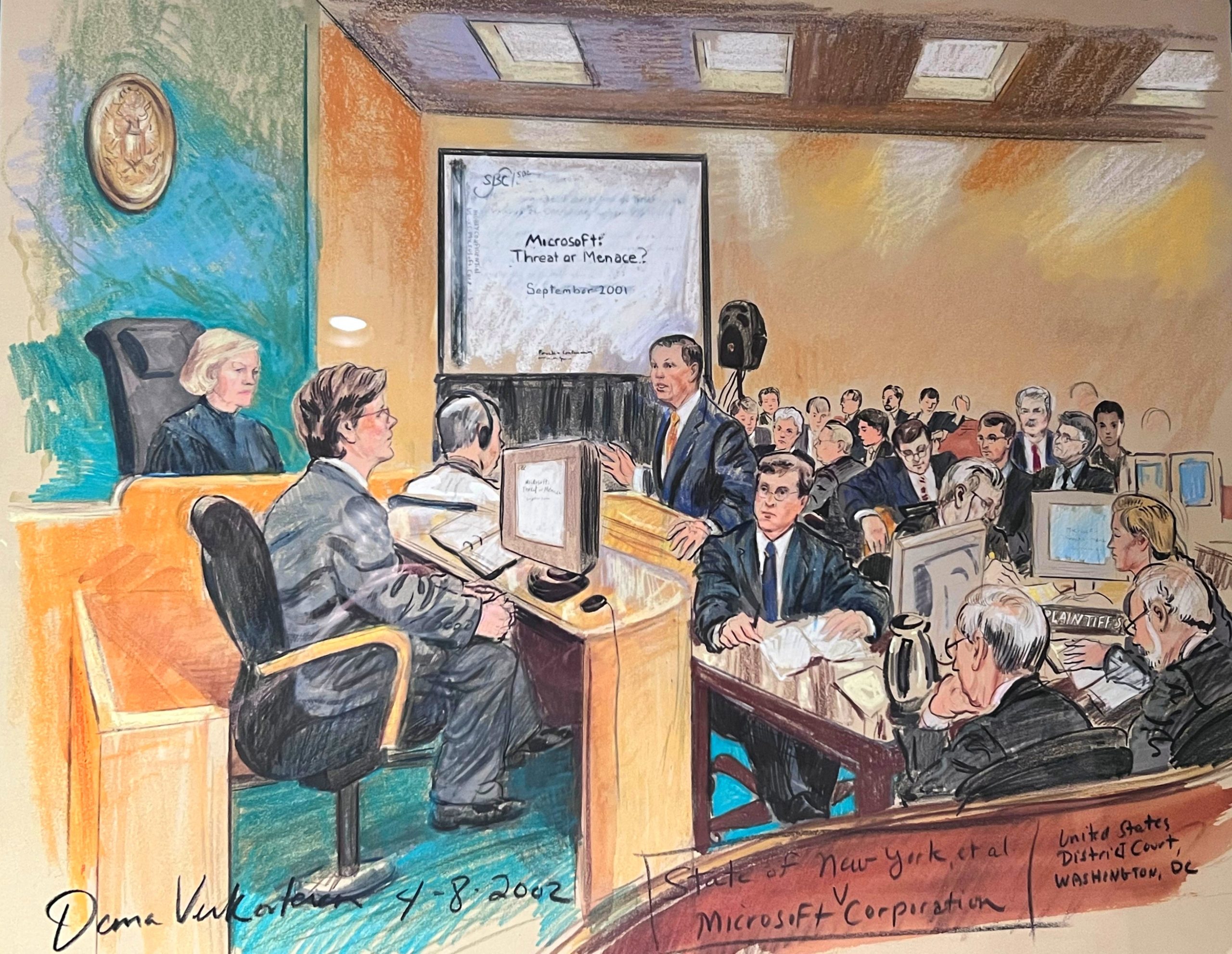
Yes, Americans are against monopolies, but the strength of that opposition has varied over time. Hawk focuses on the cycles since the 1890 Sherman Act: success in the early period with breakups in Northern Securities and Standard Oil; hibernation in the Roaring “20’s and Franklin D. Roosevelt’s first term; then more successes, like Alcoa and AT&T, into the “70’s; followed by more hibernation, with a Microsoft exception, until the 2020 election. So, while the anti-monopoly orientation never goes away, sometimes it remains dormant for quite some time.

Why the Cyclicality?

While Hawk’s fact reporting is interesting, the book probably is at its best when this long-time antitrust guru then offers up his explanation for why some of those facts occurred. At the end of the book, Hawk discusses some factors that he thinks best explain the cycles of monopoly challenges since 1890: political support; popular demand for action; changes in facts and economic conditions; changes in economic theory; legal process concerns; and the predominance of the consumer welfare standard. I will comment on three of them.

Interestingly, Hawk found that “popular support less clearly correlates with aggressive enforcement” than do some of the other elements. He sees no large anti-monopoly groundswell post World War II to accompany aggressive Section 2 enforcement. Today, despite the anti-monopoly push, “the general population appears happy to get ‘free’ platforms and relatively low-cost apps.” I would add the anecdote that at least one ranking of the most admired companies in 2022 was headed by Apple, Amazon, and Microsoft, three companies often accused of being monopolists. As Hawk puts it, popular support is helpful but not necessary to generate aggressive enforcement by the “politicians, academics, and antitrust industry generally.” As another long-time antitrust practitioner described it more than fifteen years ago, it is the true believers in the antitrust religion who often drive enforcement trends.

Continue reading →

Antitrust-for-Kids-300x143

Author:  Molly Donovan

Nathan is nine. His grandmother makes excellent meatballs using an age-old family recipe. Together, Nathan and grandma decide to can the meatballs and sell them to their neighbors on the north side of town—just in time for the holidays as a turkey side dish.

Things went great until Nathan’s friend from school, Nicole, also started selling meatballs with help from her grandma. What are the chances? Fortunately, Nicole targeted sales on her side of town (the south side), so that the two meatball-preneurs didn’t directly butt heads.

Wanting to keep things that way, Nathan asked Nicole to make the arrangement official by forming a “strategic partnership”—the gist of it being that Nicole keep her meatballs out of the north side and Nathan keep his out of the south. Nathan even offered to compensate Nicole for any lost business she suffered from the arrangement, and to keep up appearances, Nathan would arrange a few sham transactions to make it look as though each meatball maker had a few sales in the other’s territory.

The glitch, unforeseeable to Nathan, was that Nicole’s dad works for the DOJ’s Antitrust Division. Well versed on the Division’s leniency program since birth, Nicole naturally reported the conduct to the government promptly—before agreeing to Nathan’s proposed deal.

And that was all it took. Although there was no meeting of the minds, so that Nathan couldn’t get nabbed for a Sherman Act Section 1 violation (criminal conspiracy), he did get tagged for a Section 2 violation—attempted monopolization. Poor Nathan was the youngest defendant ever to plead guilty to an antitrust felony. His sentence remains pending.

Moral of the Story: This is based on a true story! Nathan Zito, president of a paving and asphalt business pled guilty in October to attempted monopolization of the highway crack-sealing services in Montana and Wyoming based on his proposal to a competitor that they allocate markets by geography. Although the competitor was already cooperating with the DOJ, precluding a prosecution for Section 1, Nathan did plead guilty to attempted monopolization and will be subject to fines and imprisonment at his sentencing in February.

Continue reading →

Contact Information