Articles Posted in Antitrust Exemptions and Immunities

Capper-Volstead-antitrust-exemption-300x214

Author:  Aaron Gott

The federal antitrust laws are a decisive proclamation that competition is the best policy—competition leads to better products and services, the greatest value at the lowest price. But, just like with anything else, there are exceptions. Congress and the courts have carved out numerous exceptions from antitrust liability—or as we’ll call them, exemptions. There’s an insurance exemption, a labor exemption, a baseball exemption, a state-action exemption, and many others. And they exist for a variety of reasons. Without the labor exemption, for example, union activity would be a felony. And we have a baseball exemption because, well, America likes baseball.

Today we’re going to talk about one important exemption for the agriculture industry: the farm cooperative exemption. Created by the Capper-Volstead Co-operative Marketing Associations Act (7 U.S.C. §§ 291–92), the farm cooperative exemption provides associations of persons or entities who produce agricultural products a limited exemption from antitrust liability relating to the production, handling, and marketing of farm products.

The farm cooperative exemption has some personal significance to me: I grew up across the street from one in my small Iowa town. And that co-op sponsored one of my little league teams.

At Bona Law, we regularly deal with antitrust exemptions. In fact, we have argued state-action exemption issues before the U.S. Supreme Court several times. As with any other exemption—and this is very important—the farm cooperative exemption is limited, disfavored, and narrowly applied. So it can easily become a trap. Like anything with antitrust, there are plenty of nuances and exceptions. We’re going to address some of those, but you should contact an antitrust lawyer if you really need to know whether the antitrust laws could apply, you’re being sued, or you want to consider suing.

The farm cooperative exemption allows a group of farmers—each of which is a competitor in the market—to come together and essentially act as one farmer. Through a cooperative, farmers pool their output together, agree on a price, and ultimately have more bargaining power in dealing with buyers—who historically were much bigger outfits than the individual farmers competing for their business.

The exemption also allows cooperatives to join together under a common marketing agency.

The exemption is overseen by the USDA, and the act gives direct oversight power to the Secretary of Agriculture. The secretary can, on his own volition, hold hearings, find facts, and issue orders to prevent cooperatives from monopolizing or restraining trade “to such an extent that the price of any agricultural product is unduly enhanced” as a result. But litigation—whether enforcement by the Department of Justice Antitrust Division or private civil lawsuits—is where a cooperative’s fate is usually decided.

Without the exemption, this sort of arrangement would be analytically indistinguishable from a price-fixing cartel, except that price-fixing cartels typically do not operate out in the open, since it is a serious felony. In fact, before 1922 when the act went into effect, farmers who acted together to market their products were sometimes prosecuted under the Sherman Act.

Conditions for the Antitrust Exemption

The Capper-Volstead Act establishes several conditions for the exemption to apply. There are two universal conditions:

Continue reading →

Baseball-Antitrust-Exemption-2-300x210

Author: Luke Hasskamp

This is the second of a series of articles examining some of the interesting intersections between the law and baseball, with a focus on baseball’s exemption from federal and state antitrust laws. (Though, like the first article, this one does not quite reach the antitrust issues, as the initial challenges were brought under contract law.)

The first article looked at some of the early conflict between professional baseball players and team owners of the National League, which largely originated from the owners’ adoption of the “reserve clause,” which effectively tied a player to a single team for the entirety of his career, subject to the team’s discretion (and ten-days’ notice). Naturally, this led to litigation, particularly as other leagues emerged that sought to compete with the National League. The National League sued several players who tried to jump to the Players League—and the players won resounding victories in those early cases, with courts refusing to find the one-sided contracts to be enforceable on the ground that they were indefinite agreements and/or lacked mutuality.

The third part of the series is Baseball Reaches the Supreme Court.

The fourth part of the series is baseball’s antitrust exemption.

The fifth part of the series is Touch ’em all, Curt Flood.

By the time the 1890 season ended—with the National League champion Brooklyn Bridegrooms and the American Association champion Louisville Colonels participating in a best-of-seven game “world” series that ended in a tie—it seemed that the reserve clause was doomed. But forces conspired to give the teams, yet again, the upper hand.

To begin, the Players League ended its first season as a financial failure, causing the League to disband. This relieved the National League of a major competitor. The National League received more good news following the 1891 season, when the American Association, another professional league, failed. This meant that, once again, there was only one professional league in town. Thus, even though the players had won important cases invalidating the reserve clause, they had nowhere else to play, which would remain the case for the next decade.

Things got a little more interesting in 1901 with the arrival of the American League, which emerged as a serious competitor. Indeed, the National League had instituted a per player salary cap of $2,400, while the American League offered salaries of up to $6,000, causing dozens of players to switch leagues.

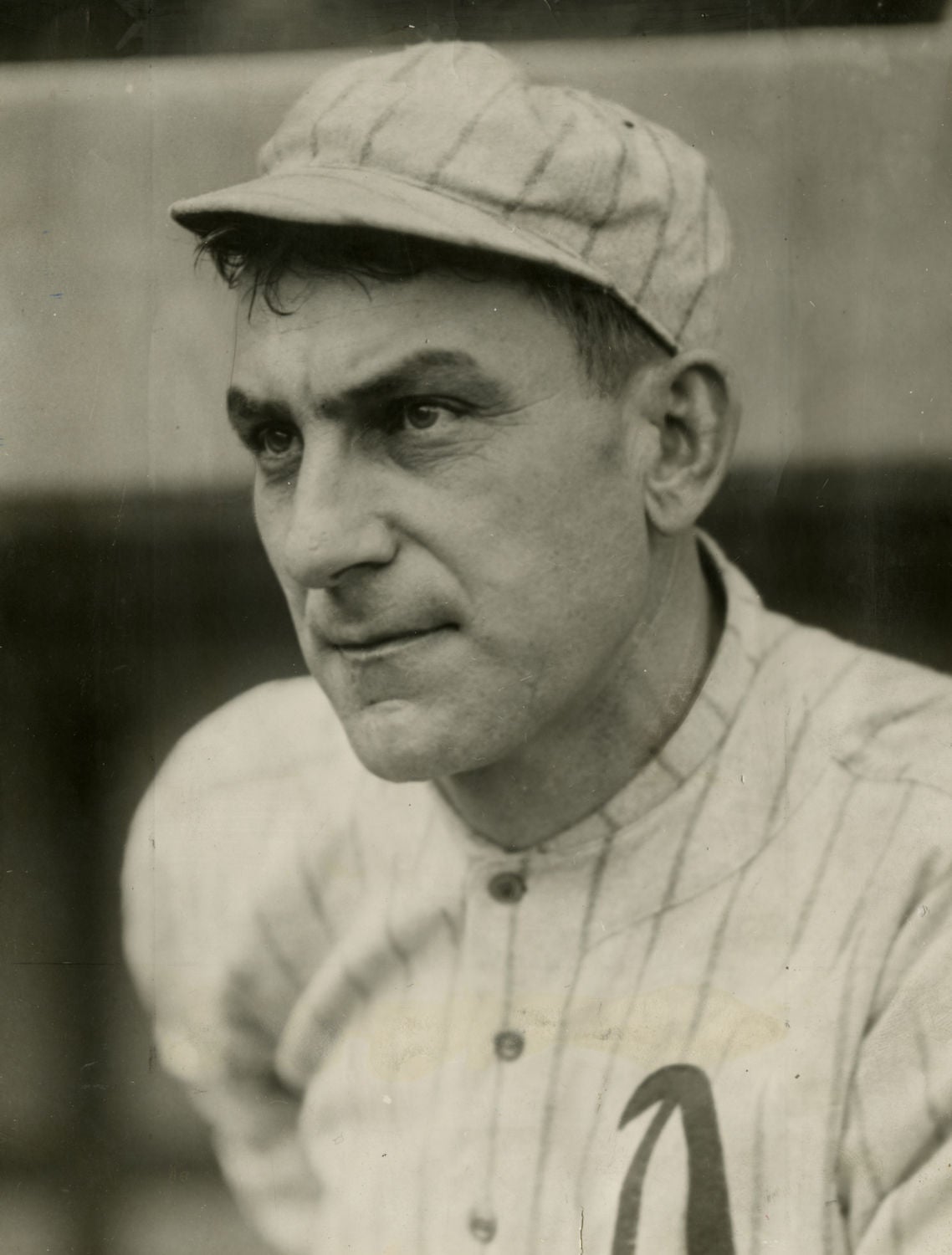
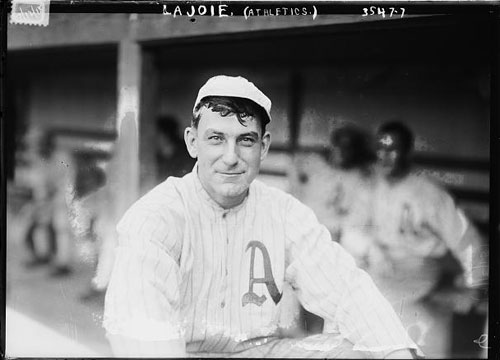
One such player was Napoleon “Nap” Lajoie, a star player for the National League’s Philadelphia Phillies. Indeed, Lajoie was one of the first superstars of the game and was highly sought by the upstart American League. (Indeed, he refused to take a bad photo.) Despite his contract with the National League, Lajoie signed with the new American League team in town: the Philadelphia Athletics (which was to be managed by Connie Mack, who remained the manager of the Athletics for an incredible 50 years—the longest-serving manager in Major League Baseball history—amassing records for wins (3,731), losses (3,948), and games managed (7,755)).

Continue reading →

Baseball-and-Reserve-Clause-300x207

Author: Luke Hasskamp

This is the first of a series of articles intended to address some of the interesting intersections between the law and baseball, particularly baseball’s curious exemption from federal and state antitrust laws. More generally, it’s about the struggle between team owners and players since the dawn of professional baseball, and some of the quirks to emerge along the way.

You can read the second part of the baseball and antitrust series here: The Owners Strike Back (And Strike Out).

The third part of the series is Baseball Reaches the Supreme Court.

The fourth part of the series is baseball’s antitrust exemption.

The fifth part of the series is Touch ’em all, Curt Flood.

This article starts at the beginning with a fledgling set of teams in the National League in the late 19th century—with team owners trying to turn consistent profits and players beginning to emerge as stars, and the tension between the two.

The trouble started in 1879, when the owners of the teams in the National League agreed on the “reserve clause” which was a provision included in player contracts that effectively bound the player to his team for his entire career. (Here’s an example of such a reserve clause.)

At the time, most National League teams were losing money and faced bleak financial prospects. To curb expenses, the teams agreed on a strategy to keep salaries down: each team would be allowed to “reserve” up to five players for the following season. This meant that no other team could sign a reserved player unless he received permission to do so.

As expected, each team elected to reserve their five best players, i.e., their most expensive players. With no market competing for players’ services, team owners were able to suppress salaries for elite talent and increase profits. Indeed, just two seasons after the adoptions of the reserve clause, most teams had become profitable, the first time that had happened.

 Due to this success, the owners saw no reason to limit the reserve clause to the top five players. They steadily increased the reserve limit until, by 1887, a team was permitted to reserve its entire roster, 14 players at the time. 1887 is also the year that the reserve clause became an explicit provision in players’ contracts; until then, it had at first been a secret agreement between the owners and then, after it leaked, simply become a league rule that all players were required to abide by. Importantly (for the owners), the reserve clause crept beyond the National League into other competing leagues that would emerge during that time, including the American Association and the American League, which both agreed to honor National League’s reserve lists.

At this time, the contracts were decidedly one sided. Although teams effectively controlled a player for the entirety of his career, nothing bound the teams to their players, except for their contracts (and virtually all contracts had one-year terms). Any player could be traded or sold at any time, and they could be released on just 10-days’ notice.

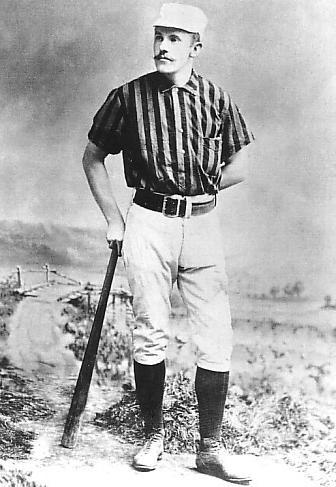
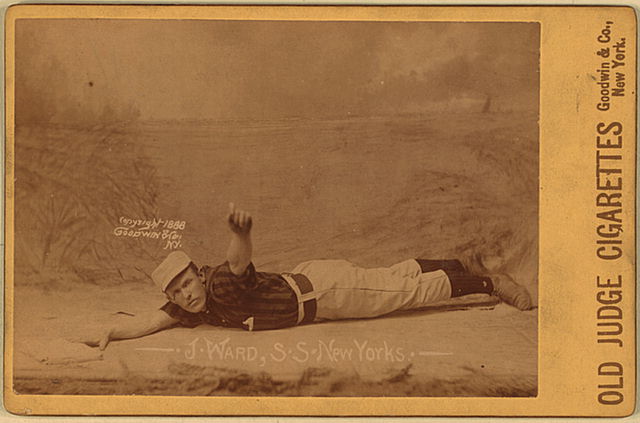
John Montgomery Ward became an important early figure in challenges to baseball’s reserve clause. Known as Monte Ward during his playing days, he began his career at 19 as a pitcher for the Providence Grays. In 1879, he went 47–19 with 239 strikeouts and a 2.15 ERA, pitching 587 innings. The following season Ward went 39–24 with 230 strikeouts and a 1.74 ERA pitching 595.0 innings. Ward also has the distinction of pitching the second perfect game in professional history as well as the longest complete game shutout, going 18 innings in a 1-0 win over the Detroit Wolverines 1–0 on August 17, 1882, a record that will never be broken. (He also has a pretty epic baseball card.)

Following an injury to his pitching arm that, remarkably, was not attributed to his workload but to a mishap while sliding, Ward’s performance as a pitcher began to diminish, so the Grays sold him to the New York Gotham before the 1883 season (they were renamed the New York Giants in 1885.) The move was fortuitous for several reasons, including the fact that it enabled Ward to enroll at Columbia Law School, where he graduated in 1885.

Using his legal training, Ward organized and led the first labor union in professional sports, the Brotherhood of Professional Baseball Players. The principal goal of the Brotherhood was to raise player salaries, which had remained stagnant even though baseball’s popularity (and revenues) had risen considerably. A chief target of the Brotherhood’s effort was the reserve clause, which continued to suppress players’ salaries and limit their mobility.

Continue reading →

State-and-Local-Government-Antitrust-Violations-300x205

Author: Jarod Bona

Lawyers, judges, economists, law professors, policy-makers, business leaders, trade-association officials, students, juries, and the readers of this blog combined spend incredible resources—time, money, or both—analyzing whether certain actions or agreements are anticompetitive or violate the antitrust laws.

While superficially surprising, upon deeper reflection it makes sense because less competition in a market dramatically affects the prices, quantity, and quality of what companies supply in that market. In the aggregate, the economic effect is huge, thus justifying the resources we spend “trying to get it right.” Of course, in trying to get it right, we often muck it up even more by discouraging procompetitive agreements by over-applying the antitrust laws.

So perhaps we should focus our resources on the actions that are most likely to harm competition (and by extension, all of us)?

Well, one place we can start is by concentrating on conduct that is almost always anticompetitive—price-fixing and market allocation among competitors, as well as bid-rigging. We have the per se rule for that. Check.

There is another significant source of anticompetitive conduct, however, that is often ignored by the antitrust laws. Indeed, a doctrine has developed surrounding these actions that expressly protect them from antitrust scrutiny, no matter how harmful to competition and thus our economy.

As a defender and believer in the virtues of competition, I am personally outraged that most of this conduct has a free pass from antitrust and competition laws that regulate the rest of the economy, and that there aren’t protests in the street about it.

What has me so upset?

Continue reading →

Baseball Antitrust Exemption

Author: Jarod Bona

Baseball is special. How do we know that? Is it the fact that it has been declared America’s Pastime? Or is it the feelings we have when we smell the freshly cut grass on a sunny spring day? Or is it the acoustics of a wood bat striking a leather-wrapped baseball? The answer is that  we know that baseball is special because the US Supreme Court has told us so.

Over the course of ninety-two years, the Supreme Court has consistently affirmed and re-affirmed a special exemption from the antitrust laws for the “business of providing public baseball games for profit between clubs of professional baseball.” There is a state action exemption, an insurance exemption, a labor exemption, and a  . . . baseball exemption? That’s right. A baseball exemption from the federal antitrust laws.

The Ninth Circuit—in an opinion courtesy of Judge Alex Kozinski—just applied this exemption in City of San Jose v. Office of the Commissioner of Baseball, which rejected San Jose’s antitrust lawsuit challenging Major League Baseball’s “attempt to stymie” the relocation of the Oakland Athletics to San Jose, California.

Update: On October 6, 2015, the US Supreme Court, without comment, declined to hear this case. Because the Supreme Court rejects the vast majority of petitions for cert., I wouldn’t read too much into this. Of course, if at least four Justices had wanted to revisit the historical exemption, they could have done so.

You might also enjoy Luke Hasskamp’s series on baseball and antitrust:

Part 1: Baseball and the Reserve Clause.

Part 2: The Owners Strike Back (And Strike Out).

Part 3: Baseball Reaches the Supreme Court.

Part 4: Baseball’s Antitrust Exemption.

Part 5: Touch ’em all, Curt Flood.

Why is There a Baseball Exemption from the Antitrust Laws?

In the 1920’s, the Supreme Court decided a case called Federal Baseball Club of Baltimore v. National League of Professional Baseball Clubs, which held that the Sherman Act didn’t apply to the business of baseball because such “exhibitions” are purely state affairs. As Judge Kozinski explained, the reasoning behind the Supreme Court’s decision reflected the “era’s soon-to-be-outmoded interpretation of the Commerce Clause.” In other words, back in the day, courts didn’t assume that almost every economic activity was within federal jurisdiction.

Thirty-years later in Toolson v. New York Yankees, Inc., the Supreme Court affirmed Federal Baseball on different grounds. The Court recognized that the Commerce Clause reasoning no longer applied, but observed that despite the Federal Baseball governing law that the federal antitrust laws don’t apply to baseball, Congress hasn’t legislated to the contrary. So it left the baseball exemption.

Finally, in 1972, the Supreme Court decided the Classic Antitrust Case of Curt Flood v. Kuhn, which is the famous baseball exemption case. The Court specifically addressed baseball’s reserve clause, which essentially prohibited free agency. When a player’s contract ended, the team still retained the player’s rights. Once again, the Supreme Court upheld the baseball exemption based upon Congress’ inaction.

Continue reading →

Teladoc antitrustIt is easier to succeed in business without competition than with it. And if you are used to practicing your profession in a particular way, it is quite uncomfortable when new approaches develop that undercut your business.

(As an aside, Aaron Gott and I just published an article for CIO Story that discussed this idea in the context of the legal profession: Disrupting the Traditional Law Firm Model.)

Indeed, the first reaction is that the “guild” scrambles to find ways to stop the newcomers, often citing health, safety, or consumer protection reasons to cover what are, in fact, really actions of self-preservation. Several years ago, I published a law review article called “The Antitrust Implications of Licensed Occupations Choosing Their Own Exclusive Jurisdiction,” that discussed the antitrust implications of this problem.

North Carolina Board of Dental Examiners v. FTC

More recently, the United States Supreme Court decided a case called North Carolina State Board of Dental Examiners v. FTC. In that case, the Supreme Court held that a state board made up of dentists was not immune from the antitrust laws when it collectively acted to limit the market for teeth-whitening to dentists.

In the NC Dental case, dentists noticed that their high-margin teeth-whitening was facing lower-priced competition from non-dentists. They predictably reacted by citing health, safety, and consumer concerns and did what they could—collectively—to destroy their competitors and thus their competition.

That they did so through what was, in fact, a state board was no concern to the US Supreme Court because when an entity—even a state entity—is made up of a group of competitors it is in many ways just like a private trade association. If the competitors collectively violate the antitrust laws by excluding competition, they must face antitrust liability.

What the Supreme Court did not do in NC Dental, however, is determine the scope of what is an antitrust violation. For that, we must turn to basic antitrust doctrine. And like any other antitrust application, doctrine develops around different types of actions and situations.

One pertinent example, of course, is the state board made up of private competitors that seek to exclude their competition. The scope of antitrust liability—separate and apart from any state-action immunity issues—is an underdeveloped area of antitrust doctrine because there weren’t a great many cases of this nature.

Continue reading →

NC Dental DecisionIf you haven’t yet heard, the Supreme Court upheld the FTC’s antitrust action against North Carolina’s state dental board. And I think they did a good job with the opinion.

We wrote an amicus brief in this case and I have been studying these issues for years, so let me tell you some of my thoughts.

Justice Anthony Kennedy wrote the Court’s majority opinion and Justice Samuel Alito filed a dissent, which Justices Antonin Scalia and Clarence Thomas joined.

State Action Immunity Background

You can read a brief summary of the case here, but here is nutshell: The North Carolina dental board, consisting mostly of practicing dentists, took certain actions to keep non-dentists from offering teeth-whitening services in North Carolina. Noticing the blatant anticompetitive conduct, the FTC sued them under the federal antitrust laws.

The issue at the Supreme Court, however, wasn’t whether the conduct violated the antitrust laws or whether it was anticompetitive, which (in my view, the FTC’s view, and the Fourth Circuit’s view) it clearly was. The issue was whether the North Carolina State Board of Dental Examiners can use what is called the State-Action-Immunity doctrine as a shield from federal antitrust law.

To invoke state-action immunity (which is technically an exemption not an immunity), an entity must satisfy the Midcal test, which requires that it show (1) the state as a sovereign clearly articulated authority for the entity to engage in anticompetitive conduct; and (2) active supervision by the state as sovereign. Under prior case law, municipalities need only show the first requirement (we will discuss this point further below).

The issue in NC Dental v. FTC (link to the Court’s opinion) was whether state licensing boards must demonstrate active supervision as well as the first prong—clear articulation. NC Dental didn’t show active supervision, so if they must do so under law, their state-action-immunity defense fails. And that is what happened.

North Carolina State Board of Dental Examiners v. Federal Trade Commission

Significantly, the second line of Justice Kennedy’s opinion is “A majority of the board’s members are engaged in the active practice of the profession it regulates.” The opinion says a lot, but this core fact—competitors regulating competitors—is what ultimately matters.

After discussing the factual context of the case, the Supreme Court started its Section II—the legal background section—with the following line: “Federal antitrust law is a central safeguard for the Nation’s free market structure.” I expect that attorneys and judges will quote this line for years. You can compare it to the Court’s quote from National Society of Professional Engineers (which was originally from Standard Oil v. FTC): “The heart of our national economy long has been faith in the value of competition.”

Here is another good line from the same paragraph of NC Dental: “The antitrust laws declare a considered and decisive prohibition by the Federal Government of cartels, price fixing and other combinations or practices that undermine the free market.” So Justice Kennedy—the Court’s libertarian?—sets a positive free-market foundation.

There is, of course, a tension between the free-market policies of the federal antitrust laws and federalism. That, in fact, is what the state-action immunity doctrine is all about. Under federalism, “in some spheres [the States] impose restrictions on occupations, confer exclusive or shared rights to dominate a market, or otherwise limit competition to achieve public objectives.” So the Court’s task is to demarcate the line between the obligations of federal antitrust law and the states’ rights to depart from this free-market policy.

You can read more about this tension between federal antitrust law and federalism in an article I wrote with Luke Wake for Competition. In that article, we argue that the Court should apply a market-participant exception to state-action immunity. That is, if a state or local government engages in commercial competition rather than regulation, it should not be able to invoke the state-action immunity shield; it must play by the same rules as other competitors. As an aside, you might notice the Court’s language in NC Dental distinguishing between regulation and market-participants. I certainly noticed it.

In resolving the tension between federalism and federal antitrust law, the Court—as it did recently in Phoebe Putney—points out that state-action immunity, like other antitrust exemptions, is disfavored.

Continue reading →

Contact Information