 The Antitrust Attorney Blog


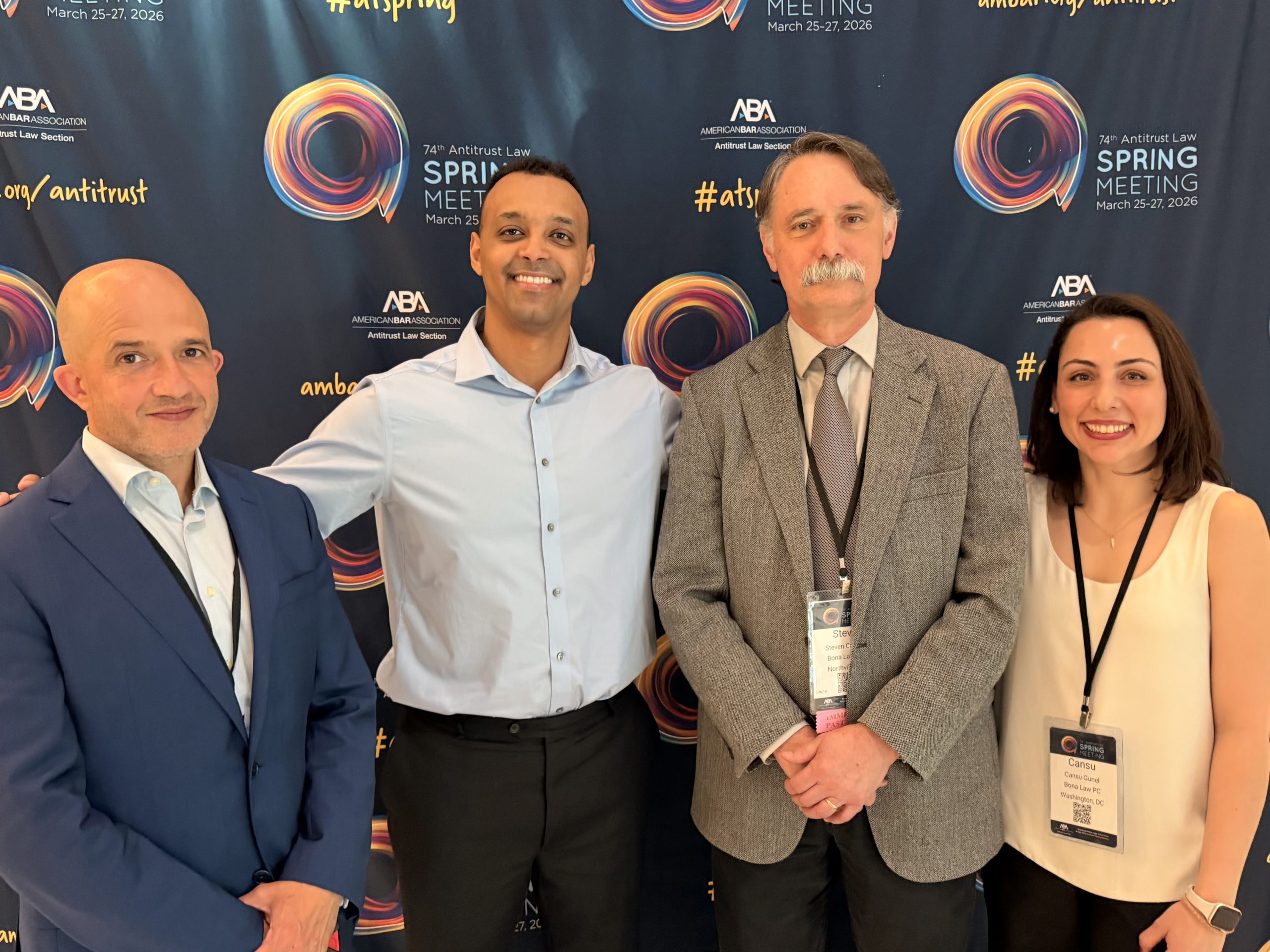
Authors: Steven Cernak, Luis Blanquez, Cansu Gunel, Sabri Siraj
Bona Law was well represented at the annual largest antitrust conference, the 2026 American Bar Association Antitrust Law Section Spring Meeting in Washington, D.C. Steve Cernak spoke at a panel discussing Robinson-Patman and other issues with big companies; Cansu Gunel attended the Section’s inaugural Trial Skills Academy; and Luis Blanquez and Sabri Siraj attended many panels and led our Bona Law meetings with clients and other firms. With dozens of panels and countless opportunities to meet with friends old and new from nearly 70 different countries, each of us could write an entire post on what we learned last week; however, to keep the length manageable, we each limited ourselves to just the key takeaways for our readers.
Steve Cernak
The results of the economy have been unsatisfactory for many global citizens for years now. As a result, many thinkers have been revisiting some of the basics of free market competition and antitrust law that, not too long ago, we thought were settled. That trend continued at this year’s Spring Meeting. Here are three examples: At the Chair’s Showcase program, noted conservative thinker Sohrab Ahmari suggested considering a return to the explicit cooperation among business, labor, and government to ensure the economy works for everyone. At my distribution panel, we discussed the wisdom of rejuvenating Robinson-Patman enforcement or supplementing it with changes or even broader state laws. Finally, immediately after the official Spring Meeting, the Dynamic Competition Initiative celebrated the birth of the Journal of Dynamic Competition with a star-studded panel discussing why and how antitrust law should focus less on static concepts like price, quantity, and efficiency and more on long-term dynamic concepts like innovation. (Disclosure: I am an editor of the new Journal.) Practitioners should prepare for big changes in the antitrust paradigms of the last generation.
Also, it was gratifying to speak with five former students whose antitrust careers are taking off. Go Blue!
Luis Blanquez
At the March 25, 2026 “Views from the Bench” panel, Judges Chen, Ginsburg, and Gonzalez Rogers devoted significant attention to how economics and expert testimony shape modern antitrust cases, particularly at the summary‑judgment stage. The judges emphasized that economic analysis remains indispensable, but they cautioned that its persuasive value depends heavily on execution, clarity, and discipline.
Across the panel, judges expressed frustration with experts who present abstract models divorced from record evidence. Economic testimony, they stressed, must be closely tied to the specific legal elements of the claim and supported by concrete facts developed in discovery. Assumptions must be transparent, and experts must address weaknesses rather than gloss over them. Judges noted that overly complex or technical submissions often obscure rather than illuminate the core competitive questions, increasing skepticism rather than credibility, especially before a jury. Daubert scrutiny—they made clear—is not a formality but an essential gatekeeping function, used to ensure that economic opinions meaningfully assist the court rather than overwhelm it.
The panel also discussed a recurring tactical issue: the “kitchen sink” approach to summary judgment. Judges repeatedly warned against filings that throw every conceivable argument into the briefing in the hope that one survives. Such strategies, they explained, often backfire. Instead of signaling strength, they suggest a lack of confidence in the core theory and force courts to wade through marginal or undeveloped claims. Judges emphasized that summary judgment is not merely a procedural hurdle but a critical moment for narrowing issues and crystallizing the case.
Effective advocacy—the judges agreed—requires restraint. Parties should focus summary‑judgment arguments on the theories that matter most, supported by coherent economic evidence and expert analysis that directly addresses causation and competitive harm. Judges made clear that credibility—with both experts and arguments—is cumulative, and that disciplined, selective advocacy, is far more persuasive than volume.
Cansu Gunel
For the first time in its history, the Antitrust Spring Meeting opened with a Trial Training Academy that featured sitting federal judges and seasoned antitrust trial attorneys from a range of career tracks as faculty. The Academy was limited to 24 participants, each assigned to represent either the defendant or the plaintiff. Participants were tasked with delivering an opening statement, conducting a cross-examination, and presenting a closing argument. Across six different rooms, both sides fought tooth and nail to impress the judges with their advocacy, all while contending with extremely well-prepared and equally tough witnesses.
The full-day event gave participants at every experience level the opportunity to receive direct feedback and unique insights from sitting federal judges on procedural issues, best practices, and even a few war stories. What made the Academy stand out, beyond having actual judges presiding, was its focus on a pressing antitrust issue: algorithmic pricing, a topic that was also explored in various panels throughout the Spring Meeting.
Another feature that made the Academy so effective was grouping participants by experience level, which allowed newer practitioners to build confidence in a supportive setting while more seasoned attorneys could push each other with advanced techniques and sharper exchanges.
All participants had put in serious preparation time, and the nerves were palpable. But every person I spoke with said how much they enjoyed the day once those nerves died down. Anyone interested in testing their skills in a trial setting should run, not walk, to next year’s Academy (and hope that the witnesses are a little nicer next time around!).
Sabri Siraj
The panel on “Cartel Enforcement in a New World Order” explored how shifting geopolitical dynamics may reshape global antitrust cooperation. Framed by questions about divergence, enforcement priorities, and institutional trust, the discussion highlighted growing uncertainty about the future of coordinated cartel enforcement. Speakers examined whether rising geopolitical tensions could undermine long-standing norms against collusion.
A central theme was concern over the evolving role of U.S. leadership in global antitrust enforcement. The panelists raised concerns that diminished clarity, consistency, or independence in U.S. policy could weaken international convergence. Questions around the independence of enforcement agencies, especially the DOJ, were raised as potential risks to cross-border cooperation. Several speakers emphasized that without strong and stable leadership from the U.S., enforcement regimes may drift apart, creating silos and reducing the effectiveness of coordinated investigations.
The discussion also touched on emerging tools such as whistleblower-payment programs. While these initiatives may increase detection domestically, panelists debated whether they could inadvertently undermine the global leniency system, which has long relied on incentives for self-reporting. If companies perceive conflicting incentives across jurisdictions, the result could be reduced cooperation and less efficient enforcement overall.
More broadly, the panel conveyed a sense that geopolitical fragmentation—combined with shifting alliances—could lead to a more complex and less predictable enforcement landscape. Rather than a unified global framework, the future may involve greater divergence in both policy and practice, though some areas of procedural convergence remain strong. Of course, we should consider whether competition and divergence among enforcers—like competition among those regulated by these enforcers—has considerable value itself.
Despite the weighty and sometimes critical tone of the discussion, the conference itself overall was remarkable. It brought together diverse perspectives from around the world and created an engaging, dynamic environment. Overall, it was both intellectually stimulating and genuinely fun to attend.